Confirm compatible air-path parts
- Verify the airflow sensor, housing, throttle body and pedal where applicable match the intended ECU and donor configuration.
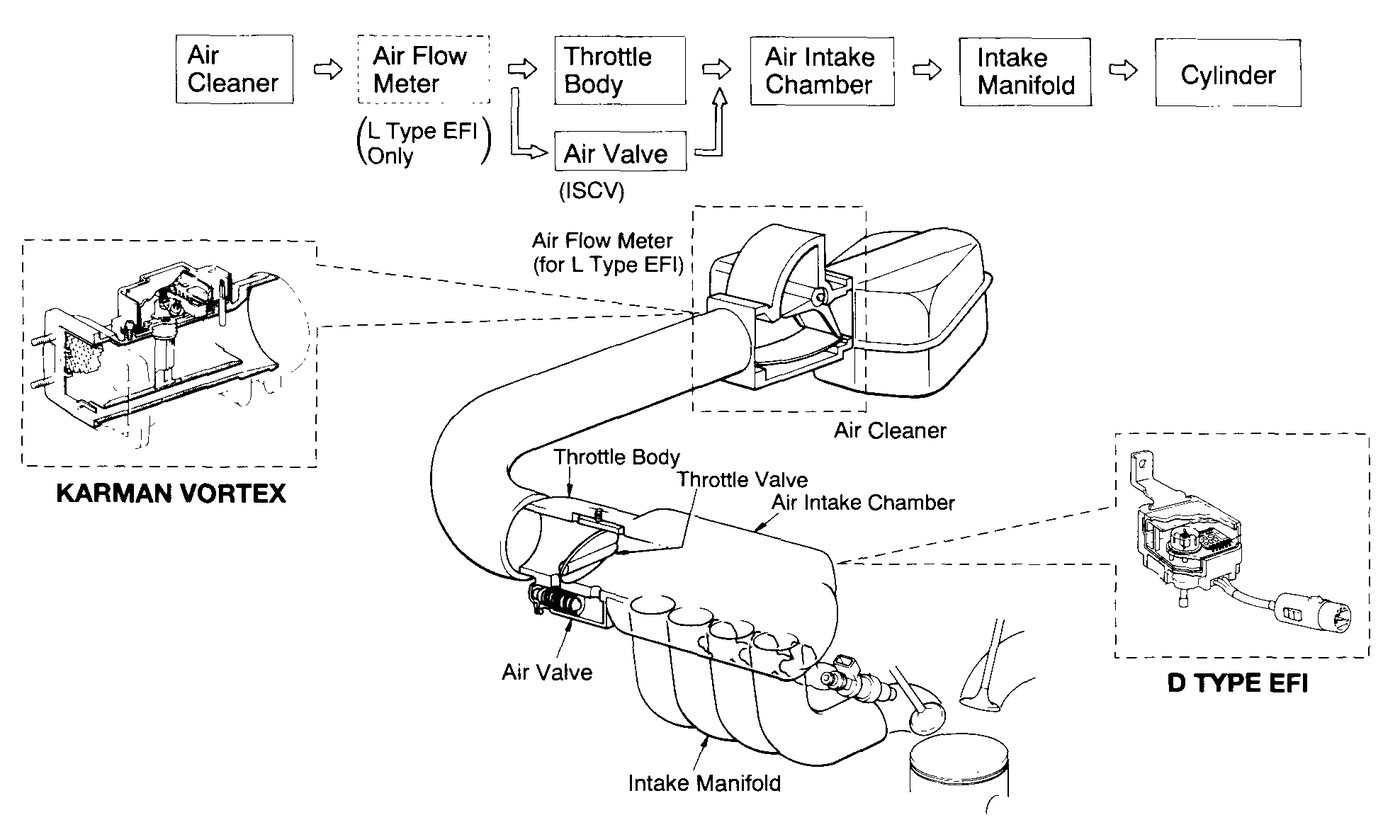
The air-induction path carries filtered air through the airflow meter or pressure-sensing system, intake duct, throttle and manifold. The ECU combines that information with engine speed, temperature and throttle state to calculate load and fuel delivery. Idle airflow may be managed by an electronic throttle or a separate bypass system, depending on the engine family.
Modified swap intake routing can introduce post-meter leaks, restrictions, incorrect sensor orientation or an air-meter housing that does not match the donor calibration. Electronic-throttle systems also require compatible pedal and throttle components. These faults can imitate fuel, ignition or ECU problems.
| Check | Expected Evidence | Diagnostic Meaning |
|---|---|---|
| Inlet path and restriction | Filter, ducting, air-meter housing and throttle inlet are correctly sized, secure and unobstructed for the donor engine configuration | A restriction or mismatched housing can reduce measured airflow and imitate a fuel, ignition or ECU problem. |
| Post-meter air-path integrity | The duct, manifold, brake-booster connection, crankcase-ventilation plumbing and capped swap ports remain sealed during an approved leak test | Air entering after the measuring point is unmetered and can cause lean correction, unstable idle, hesitation or stalling. |
| Throttle and bypass-air response | Throttle position or idle-air command changes are followed by the expected physical movement and a corresponding change in airflow and engine speed | Command without airflow response indicates binding, contamination, a restricted bypass, actuator trouble or incorrect swap plumbing. |
| Air-data plausibility through operation | Airflow or manifold-pressure data changes smoothly from key-on through cranking, idle and increased load and remains consistent with throttle, engine speed and the matched donor sensor strategy | Fixed, erratic or contradictory data points to sensor supply, ground, signal wiring, sensor or housing mismatch, or an intake-path fault before ECU replacement. |