Confirm the donor ignition system
- Identify the exact donor engine, ECU part number, ignition layout, igniter or coil application and harness variant. Use the matching factory wiring diagram and test specifications.
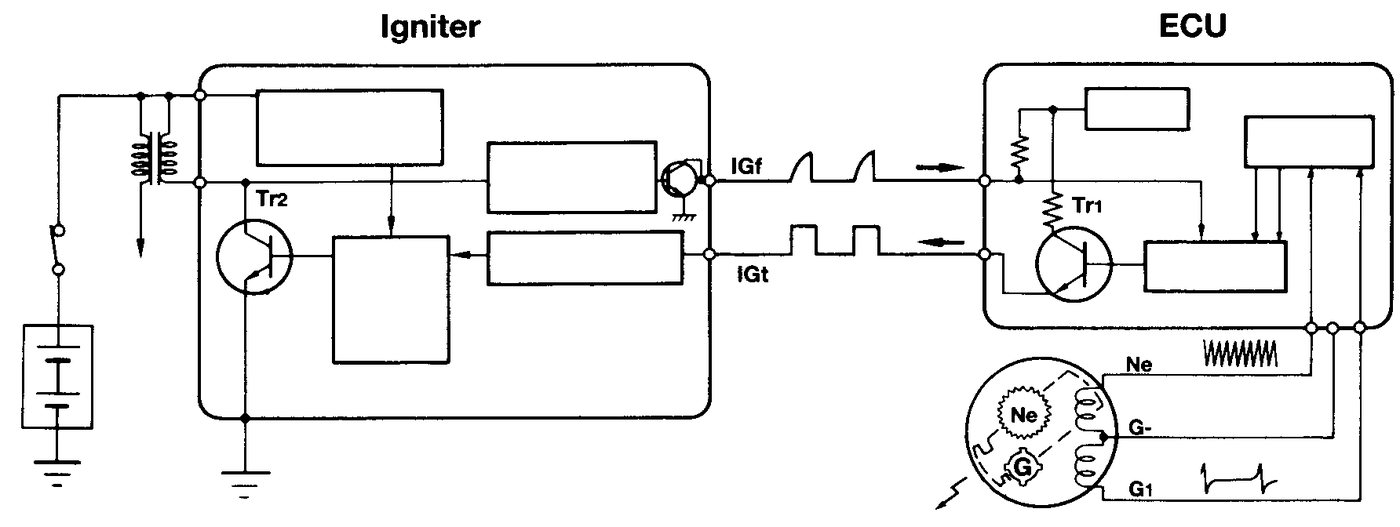
Toyota or Lexus TCCS ignition uses crankshaft and camshaft position information, engine load, temperature, throttle state, knock information and its calibration to determine ignition timing and coil control. Depending on the donor system, the ECU sends an ignition-trigger command such as IGT to an external igniter or an ignition-coil assembly, which switches primary current and produces the spark. Many systems also return an ignition-confirmation signal such as IGF, but the exact signal names, number of channels and feedback strategy vary by engine, model year and ignition layout.
In an OEM ECU swap, the ECU, position sensors, igniter or coil assemblies, engine harness, power supplies, grounds and calibration must remain compatible. A no-spark condition is not automatic proof of ECU failure: the ECU may withhold ignition when engine-position synchronization, start or range status, immobilizer authorization or another required input is missing. Diagnose the complete chain from enabling conditions and position signals through ECU command, primary switching, feedback where fitted and verified spark output.
| Check | Expected Evidence | Diagnostic Meaning |
|---|---|---|
| Crank and cam recognition | Repeatable donor-correct waveforms reach the ECU, with engine-speed and synchronization data present where supported | Missing or conflicting position evidence can prevent ignition command even when ECU power is correct. |
| Igniter or coil supply | The specified feed and ground remain stable under key-on, cranking and running conditions required by that donor system | Correct unloaded voltage that collapses during operation indicates resistance or loss in the supply or return path. |
| Ignition-trigger command | Repeatable command pulses appear at the ECU and reach the intended igniter or coil channel in step with engine rotation | A command present at the ECU but absent at the driver identifies a harness or terminal fault; no command requires prerequisite and ECU-side checks. |
| Primary switching, spark and feedback | Primary-current switching and verified spark follow the command, with ignition-confirmation feedback present where the donor system uses it | Command without switching points to the driver, coil, feed or ground; switching without spark points to the coil or secondary path; missing feedback requires circuit and component checks. |