Identify the output architecture
- Confirm the donor ECU, calibration, engine, transmission and output-device applications. Map the load feed, ECU-controlled side, relay or intermediate module and protection device.
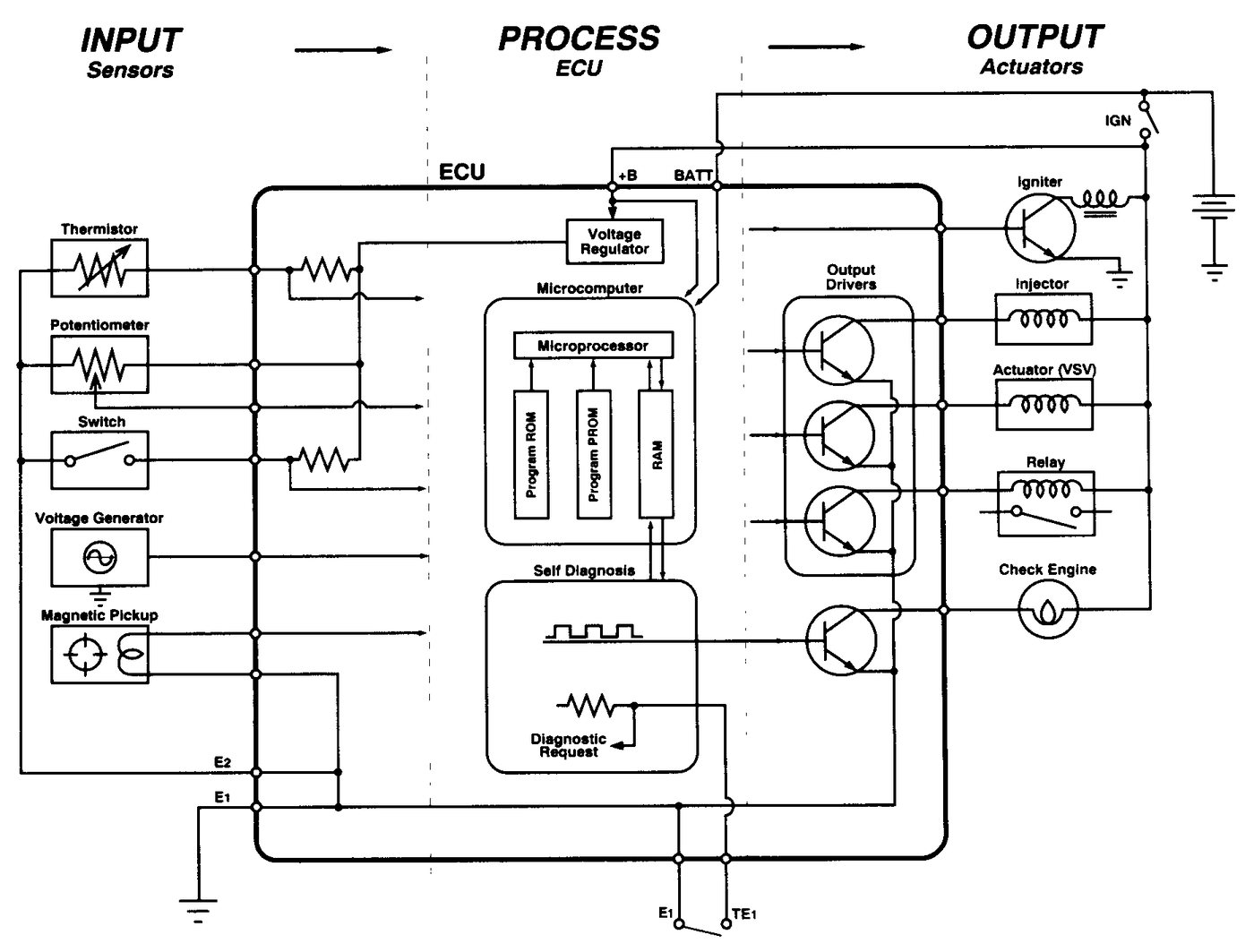
After validating its inputs, the ECU applies calibrated logic to determine injector, ignition, idle or throttle, valve-timing, relay, fan and transmission commands where fitted. An output may switch a ground, switch a supply, vary pulse width or duty cycle, or send a request to another module. Some loads receive fused power continuously while the ECU controls the return side; others operate through an external relay or controller, so the factory diagram must define the complete path.
A missing output during an OEM ECU swap is not automatic proof of ECU failure. The ECU may intentionally inhibit a command when crank and cam synchronization, start or range status, throttle plausibility, immobilizer authorization or required network information is absent. Diagnose the complete chain: required inputs, displayed command, electrical switching at the ECU, circuit delivery to the load, current flow and physical response.
| Check | Expected Evidence | Diagnostic Meaning |
|---|---|---|
| Output-enable conditions | Required synchronization, authorization, range, throttle and operating states are valid when the command should occur | A missing prerequisite can correctly suppress an output and should be repaired before driver testing. |
| Load-side supply | The relay or actuator receives its specified feed without collapsing when commanded | Correct open-circuit voltage with poor loaded voltage indicates resistance in the supply path. |
| ECU control signal | Switching or duty behaviour appears at the ECU in step with the active test or operating command | No switching after prerequisites are proven directs attention to pinout, load protection or the ECU driver. |
| Electrical and physical response | Current flow and actuator movement follow the command and meet the donor procedure | Correct control without current suggests an open load; current without intended action suggests an actuator or mechanical fault. |