Confirm component compatibility
- Match the ECU, throttle body, accelerator pedal and harness applications. Use the factory diagram to identify each position track, reference, sensor ground and closed-throttle contact.
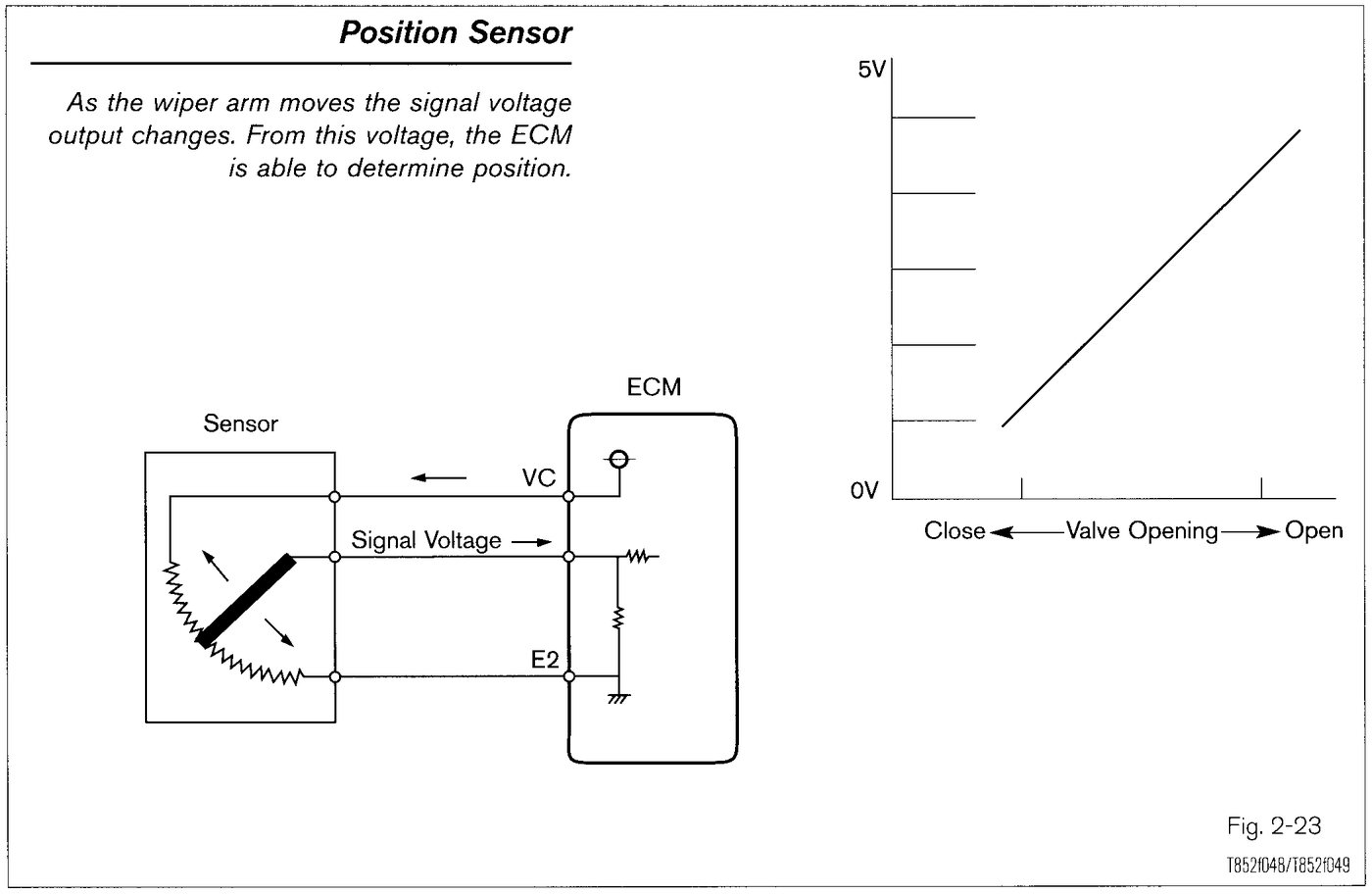
Position sensors tell the ECU the angle or travel of components such as the throttle plate and accelerator pedal. Toyota and Lexus systems may use potentiometer or Hall-effect signals, and electronic-throttle systems commonly use redundant tracks whose relationship is checked continuously. Older throttle bodies may combine an analog position signal with a separate closed-throttle contact.
For an OEM ECU swap, the ECU, throttle body, accelerator pedal where fitted and harness must be electrically compatible. A mismatched assembly, lost reference or sensor ground, mechanical binding or disagreement between redundant tracks can cause limited throttle response or fail-safe operation. Diagnosis must separate mechanical movement, sensor evidence, harness integrity, actuator operation and ECU authorization.
| Check | Expected Evidence | Diagnostic Meaning |
|---|---|---|
| Primary throttle-position sweep | Signal and scan value change smoothly and consistently from closed to open throttle | A spike, dropout or dead area indicates a sensor-track, terminal, wiring or mechanical fault. |
| Redundant throttle tracks | Both tracks remain within the manufacturer-defined relationship throughout movement | Loss of correlation suggests a mismatched throttle body, shared reference or ground fault, connector problem or internal sensor fault. |
| Accelerator-pedal tracks | Each track changes smoothly and maintains the relationship specified for that pedal and ECU combination | Correct pedal evidence with no throttle response redirects diagnosis toward ECU inhibition, throttle power, motor control or feedback. |
| Closed-throttle or idle state | ECU recognizes the closed position at mechanical rest and leaves that state as movement begins | Incorrect recognition can result from binding, an incompatible assembly, wiring error or faulty idle contact. |