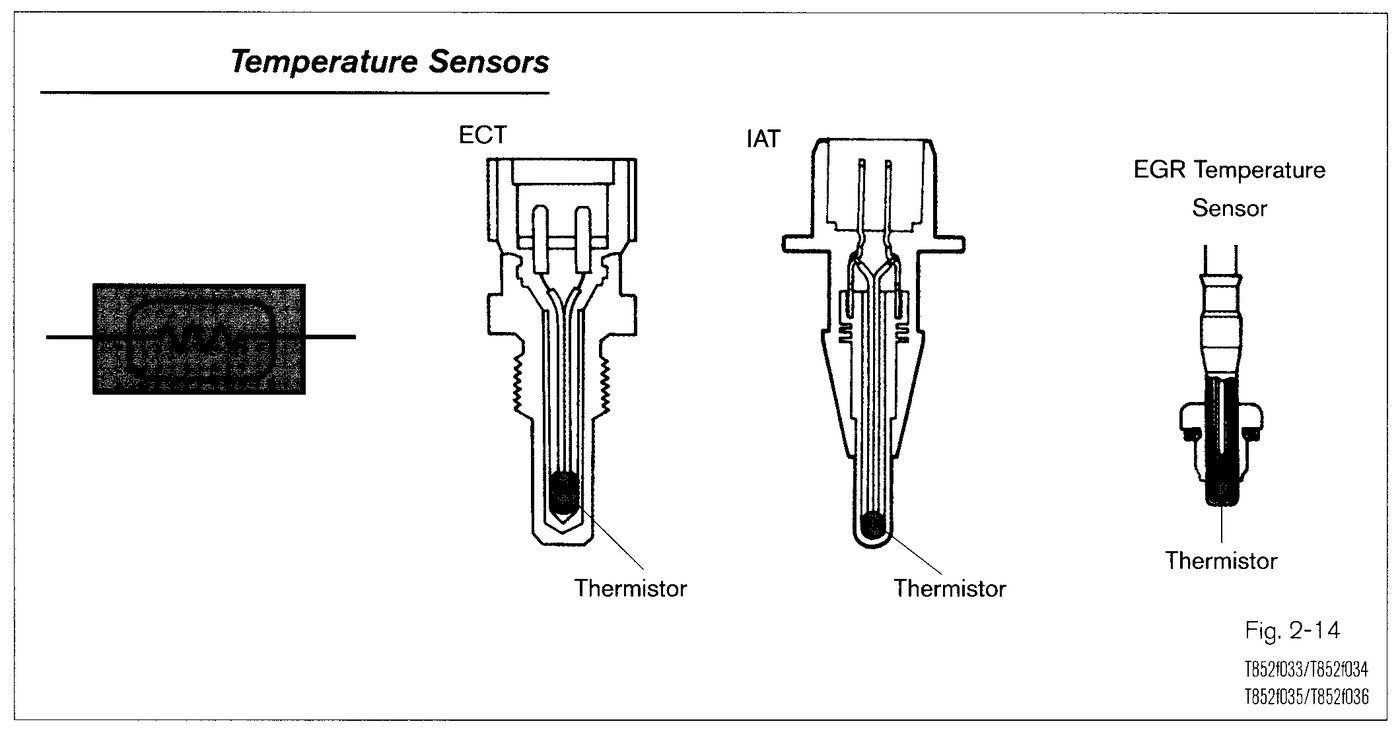
Temperature Sensors as a diagnostic page for ECU input signals, output decisions, sensor checks, and fault-code interpretation.
This page is written as a workshop training guide: learn the system, set up the test correctly, prove the circuit, interpret the result, and record the repair.
Understand what the system is meant to do before testing it.
Identify power, ground, input, output, and load points on the wiring diagram.
Use the correct meter or scope test instead of guessing at components.
Separate a wiring fault from a sensor, actuator, ECU, or mechanical fault.
Engine control diagnosis depends on understanding how the ECU sees the engine. Inputs tell the ECU about temperature, position, speed, air, pressure, knock, exhaust oxygen, and switch states. Outputs control fuel, ignition, idle, relays, fans, emissions devices, and transmission functions where fitted.
The technician should verify the electrical signal at the sensor and at the ECU where needed. A scan value can be wrong because of the sensor, the wiring, the reference circuit, the ground, the ECU input, or the interpretation strategy.
Most sensor checks should begin with reference voltage, sensor ground, and signal behavior. Then compare the signal to the real condition and to other related inputs.
| Check | Normal Result | What The Result Means |
|---|---|---|
| Battery supply | 12.4 to 12.8 volts key off on a charged battery | Low battery voltage can make good wiring look faulty. Charge or stabilize the battery first. |
| Five-volt reference | Usually close to 5.0 volts with sensor connected | A shorted sensor or harness branch can pull the reference down for several sensors at once. |
| Ground voltage drop | As close to 0.0 volts as practical under load | Voltage on the ground side means resistance in the ground path. |
| Switch or relay feed | Battery voltage on the supply side and controlled voltage on the output side | Test both sides of the load. One good side does not prove the full circuit works. |
| NTC temperature sensor | Resistance high cold and lower as temperature rises | A fixed high or low reading can be open circuit, short circuit, or sensor failure. |
| Sensor voltage | Usually higher cold and lower hot on many ECU pull-up circuits | Compare scan data to actual engine temperature. |
| Fault Type | Typical Symptom | Next Test |
|---|---|---|
| Open circuit | No current flow, no voltage on the load side, or infinite resistance when isolated. | Find the break by halving the circuit and testing from the source toward the load. |
| High resistance | Voltage appears correct with no load but drops when the circuit is asked to work. | Use voltage-drop testing under load instead of relying on continuity alone. |
| Short to ground or power | Fuse blows, signal is pinned high or low, or more than one circuit behaves incorrectly. | Disconnect branches until the fault disappears, then inspect that branch closely. |
| Wrong temperature input | Rich start, fan logic errors, poor hot restart, or incorrect idle strategy. | Compare coolant and intake temperature after sitting overnight. |
On a standalone Lexus V8 harness, always confirm the engine family, ECU part number, immobilizer state, transmission type, and body-interface requirements before applying a generic test result.
Many swap problems are caused by missing feeds, poor grounds, incorrect relay control, or connector damage rather than a failed ECU.
Record the exact result before moving to the next test. This makes the diagnosis repeatable and avoids guessing.
This training page is an independent Lexus V8 Engines LLC rewrite for educational and diagnostic support. Lexus V8 Engines LLC is not affiliated with or endorsed by Toyota Motor Corporation. Always use the correct factory service information for final specifications, safety procedures, and vehicle-specific wiring.
When a harness or ECU is being sent to Lexus V8 Engines LLC, print or save the recorded readings and include the engine, ECU, transmission, immobilizer status, connector photos, and the exact symptom.